Key Info
Bachelor of Science in Environmental Science
Are you concerned about the quality of our environment? Do you want to understand more about the global and national challenges of climate change and sustainability? Would you like a career helping to make improvements to our environment for the benefit of this and future generations? Do you want a challenging career and one tailored to meet the needs of a wide spectrum of employers? Then perhaps you should study Environmental Science at UL.
The direct entry route to Year 1 of this degree at UL is via LM066 Environmental Science.
Note: You can also enter LM066 Environmental Science via LM123 Biological and Chemical Sciences Common Entry whereby you choose LM066 Environmental Science as your exit route at the end of Year 1.
Why Study Environmental Science at UL?
Maintaining both the quality of life and a clean and healthy environment is now a major concern of Government, employers, non-governmental organisations and citizens. The EU now has a very comprehensive environmental policy, and as a Member State, Ireland is obliged to act in accordance with this policy.
More stringent environmental requirements are being placed on industry and community in areas such as energy usage, waste minimisation, waste management, recycling, water and air quality. Consequently, there is a strong demand for graduates with a scientific understanding of environmental and health and safety issues, together with a full knowledge of technological and management methods available to help improve the quality of our environment. What makes Environmental Science at the University of Limerick distinctive is its relevance to industry and business, through a focus on environmental technology, environmental management and health & safety in the workplace.
Having followed a broad common first year, you will be provided with a strong foundation in biology, chemistry and ecology, and with an in-depth knowledge in environmental technology, environmental management, conservation and waste management.
The main areas of study will include
- Environmental Science - the application of the fundamental sciences to environmental issues
- Environmental Management - how strategies can be developed and implemented to protect and sustain all aspects of the environment
- Clean Technology - the use of cleaner technologies and processes to minimise the negative impacts of technology on the environment
- Waste Management - the study of the physical methodologies and techniques for dealing with increasing levels of waste generated by the manufacturer and consumer
- Health & Safety - a complementary area to environmental science which specifically deals with significant health and safety issues both in the workplace and in outdoor environments.
Learn more about our courses and upcoming events
What you will study
The degree programme is four years in duration. Early modules are concerned with building up your understanding of core science relevant to the environment (biology, ecology, chemistry, computing, mathematics and physics) as well as core subjects in Environmental Science. The basic concepts used in these subjects are applied to specific environmental science applications. Later modules in the programme focus on the areas of environmental management, environmental technology, environmental impact assessment, geographical information systems, waste management, sustainability and conservation ecology environmental monitoring and health & safety.
In the third year, the University organises Cooperative Education for all students. This is a period of approximately eight months of paid employment for you in a position which is relevant to environmental science. This placement benefits you in a number of ways in that it:
- facilitates you in applying techniques and knowledge acquired in the University to the workplace environment,
- provides you with significant environmental experience which may be of help when seeking a position on graduation, and
- gives you the opportunity to work as part of a team to solve real problems in the workplace.
In the final year of the programme, you will undertake a research project in some aspect of environmental science. The project is supervised by an academic member of staff with specific expertise in the area and the project runs over both semesters.
| Semester 1 | Credits | Semester 2 | Credits | ||
|
CH4701 |
General Chemistry 1 |
6 |
BY4102 |
Biology for Biosciences |
6 |
|
BY4001 |
Biology 1 |
6 |
CH4102 |
Organic Chemistry 1 |
6 |
|
MA4601 |
Science Mathematics 1 |
6 |
PH4142 |
Introduction to Physics |
6 |
|
CH4021 |
Laboratory Calculations |
3 |
MA4602 |
Science Mathematics 2 |
6 |
|
CS4131 |
Introduction to Scientific Calculations | 3 |
CH4031 |
General Chemistry 2 (Inorganic) |
3 |
|
ER4101 |
Systematic Environmental Science |
6 |
CH4041 |
General Chemistry 2 (Physical) |
3 |
| Semester 3 | Semester 4 | Summer | ||
|
ER4001 |
Energy & the Environment 1 |
ER4002 |
Environmental Modelling & GIS 1 |
|
|
HS4003 |
Occupational Hygiene 1 |
BY4505 |
Pollution Biology |
|
|
CH4253 |
Inorganic Chemistry 2B |
BY4104 |
Ecology 1 |
|
|
BY4215 |
Soil Science |
CH4554 |
Environmental Chemistry |
|
|
BY4013 |
General Microbiology |
CH4354 |
Analytical Chemistry for the Environment |
| Semester 5 | Semester 6 | Summer | ||
|
ER4003 |
Environmental Modelling & GIS 2 |
Cooperative Education |
Cooperative Education | |
|
ER4507 |
Waste Management 1 |
|||
|
ER4707 |
Monitoring and Research Methods |
|||
|
CH4308 |
Discrete Analytical Methods |
|||
|
ER4407 |
Environmental Management 1 |
|
|
|
Semester 7 | Semester 8 | Summer | |
|
ER4417 |
Environmental Impact Assessment |
HS4208 |
Safety Technology |
|
|
ER4627 |
Safety & Industry |
ER4448 |
Managing Health & Safety |
|
|
CH4055 |
Environmental Catalysis |
ER4606 |
Clean Technology |
|
|
ER4405 |
Conservation Ecology |
ER4508 |
Waste Management 2 |
|
|
ER4907 |
Research Project |
ER4908 |
Research Project (cont.) |
Entry requirements
| CAO points history |
411
|
|---|---|
| Minimum grades |
Applicants are required to hold at the time of enrolment the established Leaving Certificate (or an approved equivalent) with a minimum of six subjects which must include: Two H5 (Higher Level) grades and Four O6 (Ordinary Level) grades or four H7 (Higher Level) grades. Subjects must include Mathematics, Irish or another language, and English. |
| Subject requirements |
In addition, applicants must hold a minimum grade O3/H7 in Mathematics and grade H4 in any one of the following: Agricultural Science, Applied Mathematics, Biology, Chemistry, Physics, Physics with Chemistry. |
| Additional considerations |
A Special Mathematics Examination will be offered at UL following the Leaving Certificate results for those students who did not achieve the Mathematics requirement. Mature StudentsWe welcome applications from mature students. Mature applicants must apply through the Central Applications Office (CAO) by 1 February. Application information for mature student applicants (PDF) QQI EntryCertain QQI Awards are acceptable in fulfilling admission requirements for this programme. Visit the UL Undergraduate Admissions QQI site for a full list of modules. |
| Non-EU Entry Requirements |
|
How to apply
| Where are you applying from? | How to Apply |
|---|---|
| Ireland | Irish students must apply to UL via the CAO. More information can be found here. |
| The UK | Students who have completed their A-Levels can apply to UL via the CAO. More information can be found on the Academic Registry website. |
| The EU | EU Students can apply to UL via the CAO. More information can be found on the Academic Registry website. |
| Non-Eu Country | If you are outside of the EU, you can apply for this degree here. |
Fees and funding
Student course fees are broken into three components - Student contribution, Student Levy and Tuition Fees.
A number of illustrative examples of fees for this course based on the current fee levels have been set out in the tables below.
An explanation of the components, how to determine status and the criteria involved is provided below the examples as is a list of possible scholarships and funding available.
EU Students with Free fees status in receipt of a SUSI grant
| HEA pays | Tuition Fees | €4,262 |
| SUSI pays | Student contribution | €3,000 |
| Student pays | Student Levy | €100 |
| €7,362 |
EU Students with Free fees status not in receipt of a grant
| HEA pays | Tuition Fees | €4,262 |
| Student pays | Student contribution | €3,000 |
| Student pays | Student Levy | €100 |
| €7,362 |
Students with EU fee status not in receipt of a grant
| Student pays | Tuition Fees | €4,262 |
| Student pays | Student contribution | €3,000 |
| Student pays | Student Levy | €100 |
| €7,362 |
Non-EU Students
| Student pays | Tuition Fees | €20,900 |
| Student pays | Student Levy | €100 |
| €21,000 |
Student course fees are comprised of the following components:
Student Contribution
Annual charge set by the government for all full-time third level students. All students are liable unless they have been approved for a grant by Student Universal Support Ireland (SUSI). Please refer to https://www.studentfinance.ie to determine your eligibility for a grant and for instructions on how to apply. The current student contribution is set at €3000.
Student Levy
All students are liable to pay the Student Levy of €100. Please note the Student Levy is not covered by the SUSI Grant.
Tuition Fees
These are based on Residency, Citizenship, Course requirements.
Review the three groups of criteria to determine your fee status as follows
-
Residency
- You must have been living in an EU/EEA member state or Switzerland for at least 3 of the 5 years before starting your course
-
Citizenship
- You must be a citizen of an EU/EEA member state or Switzerland or have official refugee status
-
Course Requirements
(all must be met)
- You must be a first time full-time undergraduate (Exceptions are provided for students who hold a Level 6 or Level 7 qualification and are progressing to a Level 8 course in the same general area of study).
- You must be undertaking a full-time undergraduate course of at least 2 year’s duration
- You cannot be undertaking a repeat year of study at the same level unless evidence of exceptional circumstances eg serious illness is provided (in which case this condition may be waived)
Depending on how you meet these criteria your status will be one of the following -
- Free Fee Status: You satisfy all three categories (1, 2 and 3) and therefore are eligible for the Higher Education Authority’s Free Fees scheme.
- EU Fee Status: You satisfy both the citizenship and residency criteria but fail to satisfy the course requirements and are liable to EU fees.
- Non EU Fee Status: You do not meet either the citizenship or residency criteria and are therefore liable to Non EU fees.
More information about fees can be found on the Finance website
These scholarships are available for all courses
| Title | Award | Scholarships Available |
|---|---|---|
| All Ireland Scholarships - sponsored by J.P. McManus | €6,750 | 125 |
| Cooperative Education Award | 1 medal per faculty | |
| Elaine Fagan Scholarship | €5,000 | 5 |
| Financial Aid Fund | ||
| Higher Education Grants & VEC Grants | ||
| Paddy Dooley Rowing Scholarship | €2,500 | |
| Plassey Campus Centre Scholarship Programme | ||
| Provincial GAA Bursaries Scheme | €750 | |
| Stuart Mangan Scholarship | ||
| The Michael Hillery and Jacinta O’Brien Athletics Scholarship | Various benefits equating to over €7,000 in value | |
| UL Sports Scholarships | Varies depending on level of Scholarship | Multiple |
Your future career
Employability skills from this degree
- Researching and problem-solving
- Developing arguments from scientific, ethical and philosophical perspectives
- Planning and managing projects
- Gathering, analysing and communicating complex technical data
- Flexibility in working in all kinds of environments, developed through laboratory and field-work experience
- Numerical and IT skills, developed through the application of statistics and measurement techniques
- Broad understanding of local, national and global environmental issues such as climate change, global warming and sustainability
Further Study Options
- MSc in Sustainable Resource Management: Policy and Practice
- GradDip in Chemical Engineering
- MSc in Project Management
- PhD in Environmental Science
Job titles for graduates with this degree
Graduates progressing directly into employment take up a wide variety of roles. The following provides a sample of initial roles listed on the Graduate Outcomes Survey by graduates approximately one year after graduation:
- Consultant Waste Technician
- Environmental Awareness Officer
- Environmental Consultancy
- Environmental Health & Safety (EHS) Officer
- Environmental Research
- Monitoring & Analysis Specialist
- Project Manager
- Technical Adviser
- Waste Management Technical Officer
Student profiles
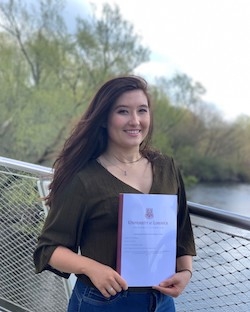
Niamh O'Sullivan
The main reason I chose UL is the Co-Op opportunity. A few third level institutions offer Environmental Science, however UL’s degree includes 8 months’ work experience. This meant that when I graduated, I would have gained skills that can only be developed in industry and I also would have relevant work experience in my future field. UL courses are focused on developing industry-ready graduates.
I was always interested in science in school, having studied both chemistry and biology, however I really enjoyed geography for my leaving cert. This course features all three subjects, along with field work and lab work, which I really enjoyed in school. Chemistry also features strongly, and even if you don’t have a strong chemistry background, the lecturers do their best to get everyone up to the same level.
My co-op experience was probably the highlight of my course experience. I worked at Irish Cement Ltd, in Drogheda Co. Louth, for my placement. Working with the plant’s Environmental Manager as part of the Environmental team, it was a great opportunity to see how environmental protection is applied to large scale industry. The job of an environmental scientist is to look at all aspects, from pollution to economy to infrastructure and quality of living, and that decisions need to be the best for everyone.
I was busy with lots of opportunities to learn both inside the office and out. I gained hands-on experience with sample collections and also got experience in filling out my first Annual Environmental Report. During my placement I also had the opportunity to work with the EPA and Natura and was invited to the annual environmental review meeting held between the Limerick and Drogheda Irish Cement sites.
My favorite part of my Co-op was the opportunity to meet and work with consultants in the field. My goal is to own my own environmental consultancy, so it was great to see that there were so many areas, from water testing to dust sample testing to biodiversity reports.
Choosing UL gave me the opportunity to work with excellent people who did their best to share their knowledge and professional experience with me.
Claudia Carey
My name is Claudia Carey, I completed my secondary level education in Salesians Secondary School Fernbank in 2016, and I am a graduate of the University of Limericks Bachelor of Science in Environmental Science Course. I graduated from the course with 1st Class Honors in 2020, and I am currently employed as a Fibre Planner with TLI Group. As a Fibre Planner I work on the behalf of National Broadband Ireland (NBI) to deliver the National Broadband Plan, providing high-speed and secure broadband connection across rural Ireland.
I chose to attend my third level education at the University of Limerick as it is a globally recognized university, with great support systems and services, world class facilities and an excellent living environment.
The course in Environmental Science got my attention, as I have had a lifelong interest in both the general sciences and the natural world. This along with the range of subjects covered in the course, from Conservation Ecology to Environmental Management, and the potential post graduate opportunities, is what lead me to decide that this was the course I wanted to pursue. For my Co-Op Placement, I spent 9 months working as an Environmental Technician in a Limerick based environmental monitoring company called AXIS Environmental Services. During my time there I went on site visits to carry out a variety of environmental monitoring tasks, wrote technical reports, and liaised with organisations, including the Environmental Protection Agency and various County and City Councils.
My Final Year Project was based on using a mapping software known as QGIS to evaluate site suitability for solar farms. By selecting relevant construction factors and creating individual maps for each, I was successful in producing a rating system to assess the appropriateness of selected sites to support the construction of a solar farm.
Through the University of Limericks Environmental Science Course, I have been given the chance to broaden my understanding of the environment, the importance of maintaining it, and have been able to further my career as a result.